The CMS Question in 2026
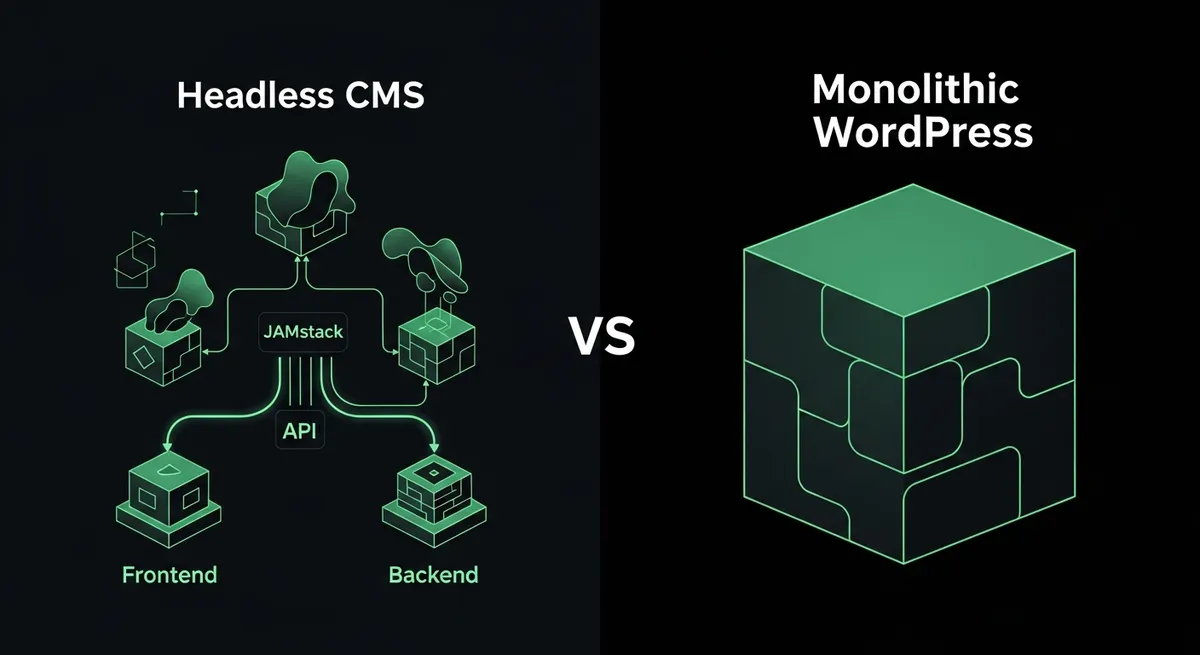
Choosing the right CMSEin CMS ist eine Software, mit der Sie Website-Inhalte ohne Programmierkenntnisse erstellen und bearbeiten können. Bekannte Beispiele: WordPress, Sanity,…Mehr erfahren → is one of the most important decisions in a website project. WordPress has dominated the market for two decades (approx. 40% of all websites). But headless architectures with CMS platforms like Sanity, Strapi or Contentful are rapidly gaining ground — especially among performance- and SEO-oriented businesses. What is the better choice in 2026?
The Performance Comparison
This is where the biggest difference lies: WordPress websites typically achieve Lighthouse scores of 30–70. Headless websites with React/Next.js routinely achieve 95–100. The reason: WordPress generates HTML server-side with PHP — every page view requires database queries and PHP rendering. Headless websites can be statically generated or delivered via edge servers — the HTML page is ready before it is even requested.
In numbers: WordPress loading time (typical): 3–6 seconds. Headless loading time: 0.5–1.5 seconds. That corresponds to 3–5× faster delivery. For SEO and conversion rate, this is a massive difference: every second of loading time costs ~7% in conversions.
Cost Comparison
WordPress: Initial development: CHF 5,000–15,000. Ongoing: Hosting (CHF 200–500/year for managed WordPress), plugin licences (CHF 100–500/year), security updates and maintenance (CHF 50–200/month).
Headless: Initial development: CHF 8,000–25,000 (30–50% higher). Ongoing: Hosting on Vercel/Netlify (often free for small sites), CMS (Sanity Free Plan for small teams), no plugin costs, minimal maintenance effort (CHF 20–50/month). Break-even: typically after 12–18 months — after that, headless is cheaper.
SEO Comparison
WordPress with Yoast SEOSEO (Search Engine Optimization) ist die Gesamtheit aller Massnahmen, um eine Website in den organischen (unbezahlten) Suchergebnissen von Google & Co. besser…Mehr erfahren → offers basic SEO functionality out of the box. But: the poor performance (slow Core Web Vitals) is an SEO disadvantage. Plugin conflicts can break SEO-relevant features. And the theme structure often produces semantically questionable HTML.
Headless websites offer: perfect Core Web VitalsCore Web Vitals sind Googles drei offizielle Metriken für Nutzerfreundlichkeit: LCP (Ladezeit des Hauptinhalts), INP (Reaktionszeit auf Eingaben) und CLS…Mehr erfahren → (direct ranking advantage), full control over HTML structure and structured data, no plugin overhead and optimal mobile performance. In our experience, headless websites rank 10–20% better than WordPress equivalents with the same content — solely through better technical SEO.
When WordPress, When Headless?
WordPress recommended: Budget under CHF 5,000, simple informational site (5–8 pages), no special performance requirements, operator wants to change everything themselves.
Headless recommended: Performance and SEO are business-critical, professional design with individual requirements, multilingual website, long-term investment (lower ongoing costs), e-commerce with custom frontend, complex integrations (CRM, ERP).
DLM Digital recommends a headless architecture with React and Tailwind CSS for the majority of Swiss SMEs. The initial investment is moderately higher, but performance, SEO and long-term maintenance costs clearly speak in favour of headless.