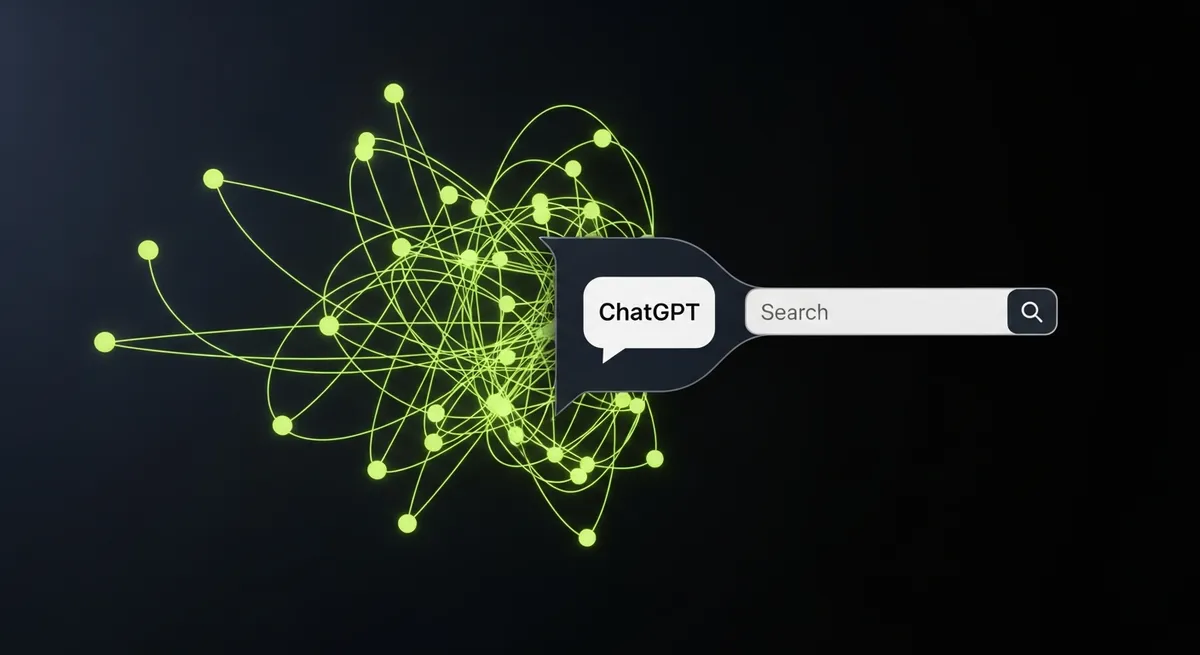
Imagine your next customer is not a human reading your website, but an AI agent that researches, compares and requests a quote on a person's behalf. That is exactly where the web is heading in 2026. With WebMCPWebMCP ist ein offener Standard-Entwurf, mit dem eine Website ihre Funktionen über die Browser-API navigator.modelContext direkt als Werkzeuge an KI-Agenten…Mehr erfahren → (Web Model Context Protocol) and the browser API navigator.modelContext, websites can for the first time hand their functions directly to AI agentsAI Agents sind autonome KI-Systeme, die eigenständig Aufgaben planen, ausführen und optimieren können — ohne menschliche Schritt-für-Schritt-Anweisungen. Sie…Mehr erfahren → as tools. Those who adopt this early get found and served — those who ignore it become invisible to the agent generation.
This guide explains, in practical terms, what WebMCP is, how it relates to classic SEOSEO (Search Engine Optimization) ist die Gesamtheit aller Massnahmen, um eine Website in den organischen (unbezahlten) Suchergebnissen von Google & Co. besser…Mehr erfahren → and GEO, which three files (llms.txt, ai.txt, webmcp.json) make your site agent-ready — and how to approach it concretely.
The web gets a second audience: AI agents
For two decades we optimised websites for two readers: humans (UX) and search-engine crawlers (SEO). In 2025/2026 a third audience arrives: autonomous AI agents. ChatGPT, Perplexity, Gemini and Claude no longer just read content — they act: they fill in forms, compare prices, book appointments and submit enquiries. The question is no longer only "does my page rank?" but "can an agent use my page?".
What is WebMCP?
WebMCP (Web Model Context Protocol) is an open draft standard that brings the Model Context Protocol (MCPDas Model Context Protocol (MCP) ist ein offener Standard, über den KI-Anwendungen einheitlich auf externe Werkzeuge, Daten und Dienste zugreifen. Statt für…Mehr erfahren →) into the browser. While a classic MCP server runs server-side, WebMCP lets a website register tools directly in the browser that an AI agent can call — each with a name, description, input schema and a function that performs the action.
navigator.modelContext — the new browser API
The technical core is the JavaScript API navigator.modelContext. A website registers its actions like this:
navigator.modelContext.registerTool({
  name: 'request_quote',
  description: 'Request a quote from DLM Digital',
  inputSchema: {
    type: 'object',
    required: ['name', 'email', 'message'],
    properties: {
      name:    { type: 'string' },
      email:   { type: 'string' },
      message: { type: 'string' }
    }
  },
  async execute(params) {
    await fetch('/api/contact', {
      method: 'POST',
      headers: { 'Content-Type': 'application/json' },
      body: JSON.stringify(params)
    });
    return { content: [{ type: 'text', text: 'Request sent.' }] };
  }
});
The agent now sees the request_quote tool, understands from the description and schema when and how to use it, and triggers the action — without screen-scraping or fragile click automation. Importantly, the API is added progressively. If the browser does not support it, nothing happens (feature detection via 'modelContext' in navigator).
WebMCP vs. MCP vs. SEO/GEO
- SEO makes your page found in classic search.
- GEO (Generative Engine Optimization) makes your content cited in AI answers.
- WebMCP lets an AI agent act on your page.
SEO brings visibility, GEOGEO ist die Optimierung von Inhalten dafür, dass sie in KI-generierten Suchantworten (Google AI Overviews, ChatGPT, Perplexity) erscheinen und zitiert werden.…Mehr erfahren → brings mention, WebMCP brings conversion through agents. The three complement each other — and all need the same foundation: structured, machine-readable content.
The three files of the agent generation
Just as robots.txt and sitemap.xml emerged for search engines, analogous files are now establishing themselves for AI:
/llms.txt
A condensed Markdown overview of your website — core offering, key pages, contact. It reduces hallucinations because the language model gets a curated summary instead of noisy HTML. Proposed by Jeremy Howard.
/ai.txt
The counterpart to robots.txt for AI crawlers: it controls which bots (GPTBot, ClaudeBot, PerplexityBot, Google-Extended …) may read, summarise and cite your content.
/.well-known/webmcp.json
A discovery manifest that tells an agent which tools your site offers and which endpoints sit behind them — for example "request a quote" on /api/contact. A minimal example:
{
  "version": "1.0",
  "tools": [
    { "name": "request_quote", "endpoint": "/api/contact" }
  ]
}
OpenAPI 3.1 — the machine-readable API
In addition, an OpenAPI 3.1 specification describes your public endpoints in a machine-readable way. Agents (and developers) see exactly which fields an endpoint expects and returns. Serving llms.txt, ai.txt, webmcp.json and an OpenAPI spec sends a clear signal: "This website is ready for the agent generation."
The foundation: semantic HTML & forms
Before any agent can "use" something, your page must be cleanly structured. The most durable — and immediately effective — investment is semantic HTML:
- Form fields with correct
name,autocompleteandaria-label - Structured data (Schema.org / JSON-LDJSON-LD ist ein Format zur Implementierung von strukturierten Daten (Schema.org) auf Websites. Es hilft Google zu verstehen, worum es auf einer Seite geht —…Mehr erfahren →: LocalBusiness, Service, FAQ)
- A clear heading hierarchy and descriptive link text
These measures help today's agents (ChatGPT Operator, Perplexity, browser agents) immediately — regardless of how fast WebMCP spreads. They also improve accessibility and SEO at the same time. A triple win.
Browser support in 2026 — an honest assessment
WebMCP is a W3C Community Group Draft (as of 2026) and still young: Chrome 146 (since March 2026) and Edge 147 have an implementation, but Chrome is still behind a flag or in an origin trial. Firefox and Safari have not committed yet. In short: do not over-invest in the experimental API itself — but adding it as a progressive enhancement costs almost nothing and future-proofs you. The investment that pays off immediately is the durable foundation (llms.txtllms.txt ist eine standardisierte Textdatei im Wurzelverzeichnis einer Website, die KI-Systemen wie ChatGPT, Perplexity oder Claude die wichtigsten Inhalte…Mehr erfahren →, ai.txtai.txt ist eine Textdatei im Stil von robots.txt, die speziell KI-Crawlern und Agenten signalisiert, welche Inhalte sie lesen, zusammenfassen und zitieren…Mehr erfahren →, OpenAPI, semantic HTML).
Why businesses should act now
First-mover advantage: those who are agent-ready today get served by the first wave of agentic research while competitors are still invisible. For local providers this is especially relevant — if a user asks their agent "find me a GEO agency in Zurich and get a quote", the site that offers the action directly wins.
Checklist: how to make your website agent-ready
- Serve
/llms.txtwith a curated content overview - Add
/ai.txtwith an AI-crawler policy - Provide
/.well-known/webmcp.jsonwith real, working tools - Publish an OpenAPI 3.1 spec for public endpoints
- Register
navigator.modelContextas a progressive enhancement (feature-detected) - Make forms semantically clean (
name,autocomplete,aria-label) - Maintain structured data (JSON-LD) for all entities
- Protect endpoints against abuse (rate limiting)
Conclusion
WebMCP marks the shift from a "readable" to a "usable" web. The technology is young, but the direction is clear — driven by Google and Microsoft. For companies that want to be visible and capable of acting in AI search, agent-ready is the logical next chapter after SEO and GEO. You do not have to build everything at once: start with the three files and clean HTML — the rest follows.
Want to make your website agent-ready? Talk to DLM Digital or calculate your project directly in the project calculator.