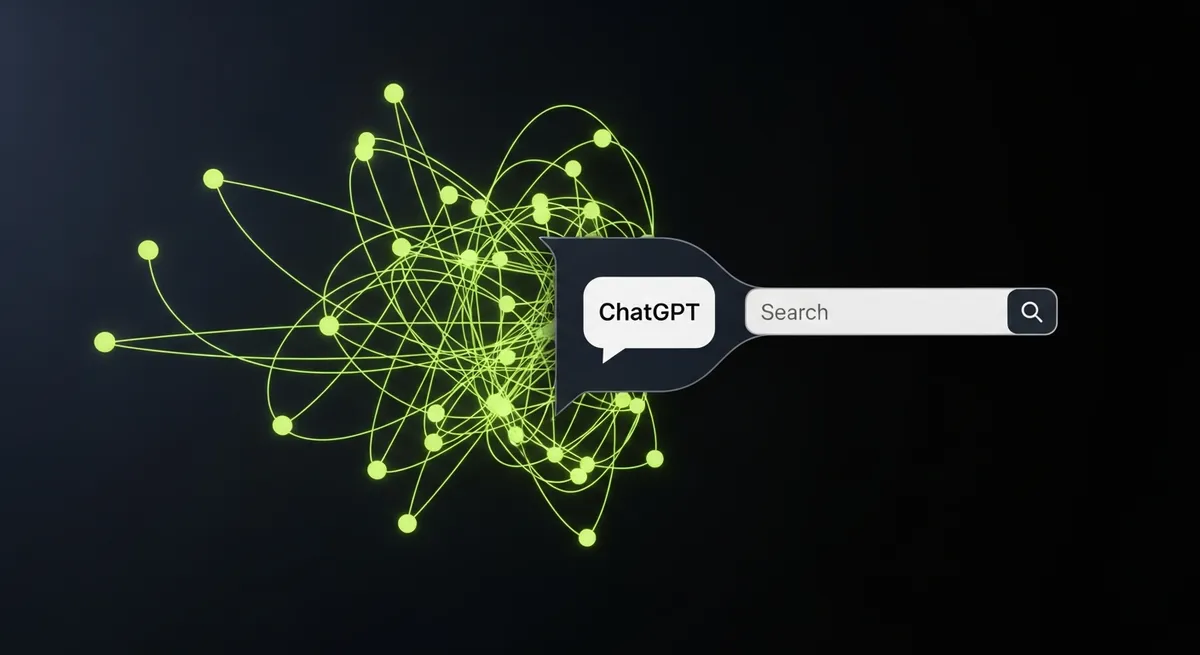
ChatGPT as a Search Engine: A New Reality
Since the launch of ChatGPT in November 2022, the search behavior of many people has fundamentally changed. Instead of querying Google with keywords, users describe their questions in natural language – and receive direct, detailed answers. According to OpenAI, ChatGPT has over 200 million weekly users (as of 2025) – a doubling within one year.
For Swiss businesses, a central question arises: How does ChatGPT change the way potential customers find information and make purchasing decisions? And what does this mean for digital strategy?
How ChatGPT Handles Search Queries
ChatGPT (especially with the GPT-4o model and integrated browsing function) can search the internet in real time and retrieve current information. ChatGPT Search has been publicly available since late 2024 and is directly integrated into the chat interface. This means: ChatGPT is no longer just a chatbot – it is a full-fledged competitor to Google that answers questions directly instead of pointing to other websites.
What ChatGPT Does Better Than Google
Answer complex, multi-part questions in a single pass ("What is the best tech stack for a Swiss startup MVPEin Minimum Viable Product (MVP) ist die kleinste lauffähige Version eines Produkts, die für echte Nutzer bereits einen vollständigen Nutzen erfüllt und…Mehr erfahren →, and what does implementation cost?"), create research and summaries from multiple sources, systematically compare pros and cons, write, explain, and debug code, and analyze and summarize documents. For all these tasks, ChatGPT is often significantly more efficient than a classic Google search followed by reading through multiple websites.
Where Google Still Dominates
Local search queries with action intent ("restaurant Zurich open now," "emergency plumber nearby"), navigation to known websites, shopping and price comparisons, current news and real-time information, and image and video search. For these use cases, Google remains the first point of contact – for now.
The Impact on Digital Visibility
Zero-Click Searches Are Increasing Massively
When ChatGPT delivers a complete answer directly, the user no longer clicks on any website. According to SparkToro data, already over 50% of all Google searches end without a click – AI chatbots are significantly amplifying this trend. For businesses that rely heavily on organic trafficOrganic Traffic beschreibt Besucher, die über unbezahlte Suchergebnisse auf Ihre Website kommen — also über Google, Bing oder andere Suchmaschinen, ohne dass…Mehr erfahren →, this is a serious strategic challenge.
Brand Mentions Are Becoming the New Currency
If ChatGPT knows your brand and mentions it positively in answers, that is potentially more valuable than a Google page 1 ranking. Ask yourself: If someone asks ChatGPT "Which web design agency in Zurich is the best?" – is your company mentioned? Invest in brand awareness, high-quality content, and digital PRDigital PR ist Öffentlichkeitsarbeit mit dem Ziel, Erwähnungen und Links auf redaktionellen Websites zu erhalten. Im Unterschied zum klassischen Linkbuilding…Mehr erfahren → – these are the factors that influence which brands AI systems recommend.
How ChatGPT Decides What to Recommend
ChatGPT bases its answers on: the training material (web data up to the cutoff date), real-time web search (when enabled), and the perceived authority and relevance of sources. To be cited by ChatGPT, your content must: be publicly accessible (no paywall), provide clear, fact-dense information, be linked or referenced by other authoritative sources, and be current and accurate.
Strategies for the AI Era: What Swiss Businesses Should Do Now
1. Become a Citable Source
AI systems prefer sources with high authority and fact density. Create: original studies and surveys (even small, industry-specific ones), detailed guides with concrete numbers and empirical values, expert statements and interviews, and data visualizations and infographics with proprietary data. This type of content is not only preferred by AI systems – it is also valuable for GEO and traditional SEO.
2. Build Direct Customer Relationships
Newsletters, community, and direct touchpoints become more valuable as organic search visibility decreases. Concrete measures: build a high-quality newsletter (goal: reach your audience without Google dependency), build a community on LinkedIn or on your own platform, nurture personal relationships (especially critical in the Swiss B2B market), and create recurring formats (webinars, podcasts, regular industry updates).
3. Actively Strengthen Local Business
"Reserve a restaurant in Zurich," "Call a plumber in Bern" – for local, action-based search queries, Google Maps and Google Search remain dominant. Local businesses are less heavily affected by the ChatGPT disruption. Invest in your Google Business ProfileGoogle Business Profile (früher: Google My Business) ist das kostenlose Google-Tool zur Verwaltung Ihres lokalen Unternehmensauftritts. Es steuert, was in…Mehr erfahren →, local reviews, and local content strategy – these measures are relevant for both Google and AI systems.
4. Optimize Content for AI and Humans Simultaneously
The good news: content optimized for AI systems is also valuable for humans. Write clearly and structuredly (H2/H3 headings as questions), deliver concrete numbers and facts instead of vague statements, cite sources and make your expertise transparent, and update content regularly (AI systems prefer current information).
ChatGPT for Swiss SMEs: Concrete Use Cases
Beyond the search function, ChatGPT is also changing how businesses work internally. For Swiss SMEs, concrete applications include: automated customer communication (email responses, chatbots on the website), content production (blog posts, social media texts, newsletter drafts), data analysis and reporting (summaries from Excel data, quarterly reports), translations and multilingual communication (especially valuable in the trilingual Swiss market), and research and competitive analysis (summarizing market trends, price comparisons, industry reports).
According to a McKinsey study, knowledge workers can automate 60–70% of their time-consuming routine tasks through generative AI. For a typical Swiss SME with 10 employees, this potentially means 30–50 saved work hours per week – if the tools are used correctly.
ChatGPT and Data Privacy: What Swiss Businesses Need to Consider
When using ChatGPT in a business context, data privacy aspects are central. Basic rule: do not enter any confidential customer data, trade secrets, or personal data into the free ChatGPT version. OpenAI potentially uses inputs from the free version for training. Secure alternatives: ChatGPT Enterprise or Team (data is not used for training), Microsoft Azure OpenAI Service (GDPR-compliant, data stays in the EU), local open-source models (Llama, Mistral) for particularly sensitive applications. For Swiss companies subject to the Swiss Data Protection Act (nDSG), we recommend an internal AI policy that regulates which data may be entered into which tools.
The Future: ChatGPT as a Platform
OpenAI is increasingly developing ChatGPT into a platform: GPTs (custom chatbots) that companies can create for their customers, plugins and integrations with business tools (CRM, email, calendar), the ChatGPT API for custom applications, and voice interfaces (ChatGPT Voice) for phone-based customer interaction. For Swiss businesses, this means: ChatGPT is not just a tool for information search but is increasingly becoming infrastructure for customer interaction and business processes. Those who understand and leverage this development early gain an advantage over competitors who still dismiss ChatGPT as a "gimmick."
Checklist: Is Your Business Ready for the AI Era?
Use this checklist to assess how well your business is prepared for the AI-driven search landscape: (1) Does your company appear when you ask ChatGPT about your industry + region? (2) Have you implemented structured data (Schema.org) on your website? (3) Is your content fact-dense, supported by sources, and regularly updated? (4) Have you built a newsletter or other direct customer channels? (5) Is your Google Business Profile fully optimized? (6) Do you regularly publish expert knowledge on your blog? (7) Are you linked or cited by other authoritative websites? (8) Do you have a clear brand positioning that AI systems can accurately reflect? If you can answer fewer than 5 of these points with "yes," there is a need for action – and right now, before your competitors close these gaps.
ChatGPT for Local Businesses: Opportunities in the Swiss Market
Local Swiss businesses – from craftspeople to restaurants to medical practices – face a particular opportunity: ChatGPT is increasingly used for local recommendations ("Best dentist in Zurich?", "Web design agency nearby?"). The data sources for such recommendations are primarily Google Business Profile reviews and information, content on your own website (especially FAQ pages and service descriptions), business directories and review platforms (local.ch, search.ch), and mentions in local media and blogs. To appear in ChatGPT recommendations, local businesses need a strong digital presence across multiple channels. A single good Google ranking is no longer enough – AI systems aggregate information from dozens of sources and prefer businesses with consistent, positive presence across the entire web.
Act Now: Secure Visibility in the AI Era
The AI revolution in search is real, but it is not a reason to panic – it is a reason to act. Companies that now understand how AI systems work and what content these systems prefer can secure a tangible competitive advantage. The fundamental principles remain the same: quality, relevance, and authority. Also read our article on Answer Engine Optimization (AEO) to strategically expand your approach. What is changing is the nature of visibility – and the smartest companies are diversifying their digital presence rather than relying on a single channel.