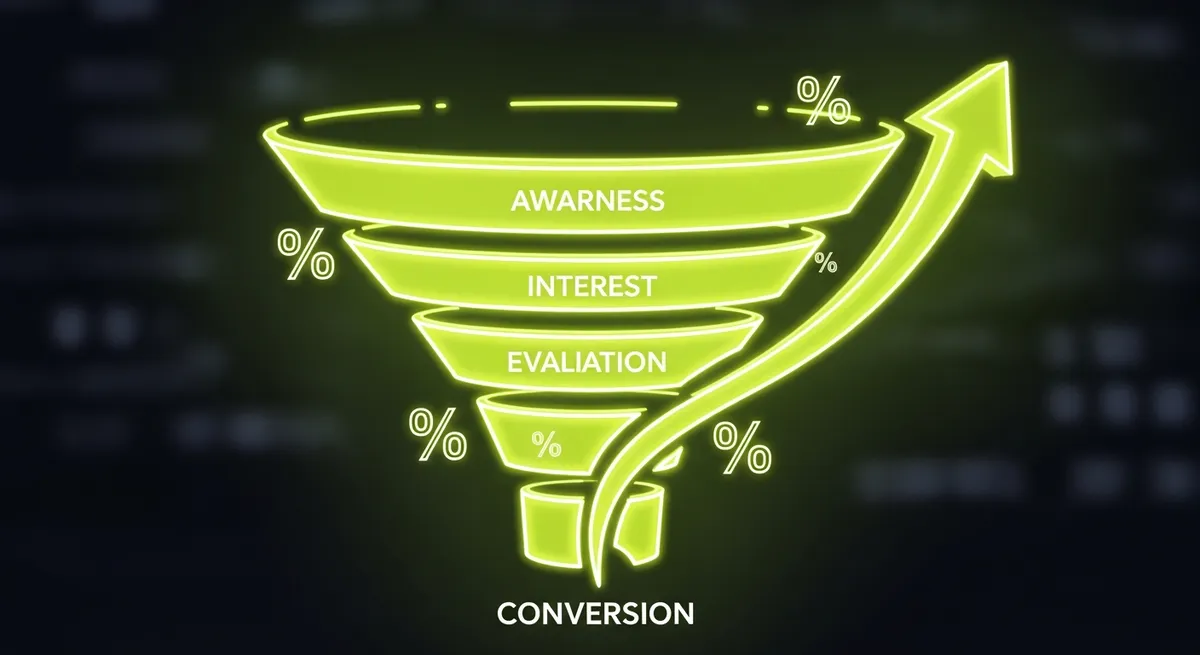
What Is Conversion Rate Optimization?
Conversion RateDie Conversion Rate misst, wie viel Prozent Ihrer Website-Besucher eine gewünschte Aktion ausführen — z.B. ein Formular ausfüllen, ein Produkt kaufen oder…Mehr erfahren → Optimization (CRO) is the systematic improvement of a website with the goal of converting a higher proportion of visitors into customers, leads, or other desired actions. Instead of generating more traffic, CRO focuses on making better use of existing traffic – and that's exactly what makes CRO one of the most profitable marketing measures of all.
The conversion rate is calculated simply: (Conversions / Visitors) x 100 = Conversion Rate in %. An improvement from 1% to 2% means twice as many customers from the same traffic – without spending a single franc more on advertising.
Why CRO Is Particularly Rewarding for Swiss SMEs
In Switzerland, the costs for traffic acquisition are high: Google Ads click prices are CHF 5–25 per click for many industries. If your website converts only 1% of visitors, you're effectively paying CHF 500–2,500 per lead. Double the conversion rate to 2%, and you halve the cost per leadCost per Lead (CPL) sind die durchschnittlichen Kosten, bis ein Kontakt entsteht: eingesetzte Kosten geteilt durch die Anzahl gewonnener Leads. Die Zahl ist…Mehr erfahren → – with 1,000 monthly visitors, that quickly saves thousands of francs.
According to a Wordstream analysis, the average conversion rate across all industries is 2.35%, while the top 25% of websites achieve 5.31% and more. This shows: there is enormous improvement potential.
Typical Conversion Rates in the Swiss Market
The average conversion rate varies greatly by industry and objective: E-commerce Switzerland: 1–3% (Digitec, Galaxus are higher thanks to strong brand awareness), B2B lead generationLead Generation (Leadgenerierung) beschreibt den Prozess, potenzielle Kunden zu identifizieren und ihre Kontaktdaten zu gewinnen — über Formulare, Newsletter,…Mehr erfahren →: 2–5% (for contact forms and demo requests), SaaS free trial: 3–7%, newsletter sign-up: 1–5%, and simple contact forms: 3–8%. If your rates are below these, there are clear optimization potentials.
The Most Important CRO Levers for Swiss Websites
1. Communicate the Value Proposition More Clearly
The most common reason for low conversion rates: Visitors don't understand quickly enough why they should buy from you specifically. Your value proposition – the unique value you offer – must be clear within 5 seconds. Test different headlines, USP formulations, and positioning.
Swiss consumers particularly value: quality promises, local proximity ("your partner in Zurich"), transparency in prices and terms, and trust through references from other Swiss companies.
2. Use Social Proof Strategically
Reviews, testimonials, customer numbers, and certifications build trust. In the Swiss market, local references are particularly effective: Swiss companies trust other Swiss companies. Show logos of your Swiss clients, use Google reviews with specific star ratings, and place testimonials with real names and companies – anonymous reviews are hardly convincing in the Swiss market.
3. Radically Simplify Forms
Every additional form field costs conversions – according to HubSpot, reducing from 4 to 3 fields can increase the conversion rate by up to 50%. Reduce forms to the absolute minimum: Name and email for newsletters, name, email, and a short message for contact inquiries. Collect additional information in the follow-up, not in the form.
4. Optimize the Call-to-Action
CTAs must be clear, action-oriented, and prominent. "Contact us" is weaker than "Book a free consultation" or "Non-binding quote within 24h." Systematically test the color, position, text, and size of your CTAs. In our experience, CTAs work best in the Swiss market when they communicate a specific benefit and a timeframe.
5. Treat the Mobile Experience as a Priority
Over 55% of Swiss web traffic comes from mobile devices. A poor mobile experience is one of the biggest conversion killers. Common mobile mistakes: Buttons too small to tap (minimum 44x44 pixels), forms difficult to fill out, pop-ups that block the entire screen, and horizontal scrolling. Test your website regularly on real mobile devices, not just in browser simulations.
6. Loading Time as a Conversion Factor
According to Google, the bounce rateDie Bounce Rate (Absprungrate) misst den Anteil der Website-Besucher, die eine Seite besuchen und ohne weitere Interaktion wieder verlassen. In GA4 wurde sie…Mehr erfahren → increases by 32% when loading time goes from 1 to 3 seconds. For e-commerce websites, each additional second of loading time can reduce the conversion rate by 7%. Invest in performance optimization – it is one of the most measurable CRO measures.
A/B Testing: The Scientific Approach
A/B testingA/B Testing (Split Testing) ist eine Methode, bei der zwei Varianten einer Webseite, Anzeige oder E-Mail an verschiedene Nutzergruppen ausgespielt werden, um…Mehr erfahren → is the systematic testing of two variants of an element. You show 50% of visitors version A and 50% version B and measure which converts better. Tools like VWO, Optimizely, or Google Optimize (or its successor AB Tasty) make A/B testing accessible even for SMEs.
Important: Test only one variable at a time. If you simultaneously change the color, text, and position of the CTA, you won't know what made the difference. And: Wait for statistical significance (at least 95% confidence) before making decisions – premature conclusions based on few visitors lead to wrong decisions.
What You Should Test First
In this order: (1) Headline and value proposition, (2) CTA text and color, (3) Hero image or video, (4) Form layout and number of fields, (5) Social proof placement. These elements have the greatest impact on the conversion rate and deliver the fastest, measurable results.
Heatmaps and Session Recordings: Qualitative Analysis
Tools like Hotjar or Microsoft Clarity (free) show you how users actually interact with your website: where they click, how far they scroll, and where they drop off. These insights are often more revealing than quantitative data alone.
Typical findings from heatmapEine Heatmap visualisiert das Nutzerverhalten auf einer Webseite durch Farbcodes: Rot zeigt Bereiche mit hoher Aktivität (Klicks, Scrolltiefe, Mausbewegung),…Mehr erfahren → analyses: Users click on elements that are not links (visually misleading), important CTAs are placed below the average scroll depth, users spend a lot of time on elements with little conversion value, and form fields are filled out in an unexpected order.
CRO Budget and ROI
A professional CRO analysis and initial optimization typically costs CHF 3,000–8,000 in Switzerland. Ongoing optimization with monthly tests: CHF 1,000–3,000. The ROI is often impressive: Doubling the conversion rate from 1% to 2% for an e-commerce shop with CHF 100,000 monthly revenue means CHF 100,000 in additional annual revenue – an investment that pays for itself within a few months.
CRO and Psychology: Understanding Conversion Triggers
Effective CRO is based on understanding human decision psychology. The most important psychological triggers for Swiss websites: Scarcity: "Only 3 spots available" or "Offer valid until Friday" – but only use this when it's true. Swiss consumers are particularly sensitive to manipulative tactics. Social Proof: Customer reviews, logos of well-known clients, case studies with measurable results. According to BrightLocal, 87% of consumers read online reviews before making a purchase decision. Authority: Certifications, awards, expert status – particularly effective in the Swiss market, where quality and reliability have high priority. Reciprocity: Free tools, checklists, or initial consultations create a psychological obligation and lower the barrier for an inquiry.
Mobile CRO: The Underestimated Conversion Killer
In Switzerland, over 60% of traffic comes from mobile devices, but the mobile conversion rate is typically 50–70% below the desktop rate. The most common reasons: Touch targets too small (buttons under 44x44px), complex forms without mobile optimization, missing mobile payment options (Apple Pay, Google Pay, Twint), slow loading times on mobile networks, and pop-ups that block the entire mobile screen. A targeted mobile CRO optimization – larger CTAs, simplified forms, sticky navigation, and one-click checkout – can increase the mobile conversion rate by 30–60%. Landing page optimization also plays a central role here. Particularly for Swiss e-commerce, integrating Twint as a payment method is a strong conversion lever – over 5 million Swiss people actively use Twint, and the checkout abandonment rate drops significantly when users can pay with their preferred payment method.
CRO Tools for Swiss SMEs: Recommendations by Budget
Depending on the budget, we recommend the following CRO tool stacks: Budget entry level (CHF 0–100/month): Google Analytics 4 (free) for data analysis, Microsoft Clarity (free) for heatmaps and session recordings, Google Optimize (free) for simple A/B tests. Professional (CHF 200–500/month): Hotjar Business for advanced heatmaps and surveys, VWO or AB Tasty for professional A/B tests with statistical significance, Unbounce for quick landing page tests. Enterprise (CHF 500+/month): Optimizely or Kameleoon for server-side tests and personalization, Contentsquare for in-depth UX analyses, UserTesting for moderated user tests with Swiss target audiences. Regardless of budget: Start with free tools and invest in premium solutions only when you have an established testing process and know which features you actually need.
CRO Is Not a Project, but a Process
Conversion Rate Optimization is not a one-time project but a continuous improvement process. The most successful companies regularly conduct tests, learn from the results, and optimize systematically. Even small improvements – 0.5% here, 1% there – add up over time to noticeable results. Combine CRO with solid performance optimization for maximum impact.