Why Branding Matters So Much for Startups
"The product is the marketing" – this statement is true, but incomplete. A great product with poor branding loses out to an average product with a strong brand. Branding is the first impression potential customers have of you – even before they try your product.
For Swiss startups, professional branding is especially important because Swiss consumers have high aesthetic standards and great quality expectations. According to a Lucidpress study, consistent branding increases revenue by an average of 23%. In a competitive market like Switzerland, that makes a measurable difference.
Step 1: Establish the Strategic Foundation
Define Purpose and Vision
Why does your company exist? What would the world be like without it? These fundamental questions form the basis for everything that follows. Your purpose is not your product – it is the "why" behind it. A software company does not sell software; it sells "efficiency and freedom for entrepreneurs." Simon Sinek's "Start with Why" principle applies especially to branding: customers don't buy what you do – they buy why you do it.
Formulate your purpose in a single sentence: "We exist to help [target audience] solve [problem] so that [outcome]." This sentence becomes the compass for all subsequent branding decisions.
Define Your Target Audience Precisely
Who exactly are your customers? Not "companies in Switzerland" – that is too vague. Create concrete buyer personas with: demographic data (age, position, industry, region), psychographic characteristics (values, fears, motivation), buying behavior (decision-making process, budget, information sources), and specific quotes from real customer conversations.
For the Swiss market, the language region is an important factor: a brand that needs to work equally well in Zurich and Geneva requires a different strategy than a purely German-speaking brand.
Positioning and USP
How do you differentiate yourself from the competition? Positioning is not "we also do that" – it is "we are the only ones who..." A clear positioning attracts the right customers and repels the wrong ones – and that is a good thing. Use the positioning statement: "For [target audience] who has [need], [brand] is the [category] that [unique advantage] because [proof/reason]."
Step 2: Verbal Identity
Define Your Brand Voice
How does your brand speak? Formal or casual? Technical or simple? Humorous or serious? The brand voice influences all texts: website, social media, emails, contracts, invoices. Consistency is key – a company that communicates casually on Instagram and stiffly on its website confuses its audience.
Define your brand voice using 3–5 adjectives and create a "Do/Don't" list for each. Example: "Direct" → Do: "We build your website in 6 weeks." Don't: "It could potentially be realized within a timeframe of approximately 6 weeks."
Naming and Tagline
A good brand name is memorable, easy to pronounce, scalable (does it work internationally?), and ideally free of trademark conflicts. Check availability at the IPI (Swiss Federal Institute of Intellectual Property) and verify .ch domain availability. Costs for trademark registration in Switzerland: from CHF 550 (one class, 10 years).
Your tagline should communicate what makes you unique in 3–7 words. It doesn't need to be clever – it needs to be clear. "Just Do It" (Nike) and "Think Different" (Apple) work because they communicate a clear attitude.
Step 3: Visual Identity
Logo Development
A good logo is simple, distinctive, versatile, and timeless. It works in black and white just as well as in color, small on a business card as well as large on a poster. Invest in a professional graphic designer or agency – a logo contest on Fiverr rarely delivers a strong brand identity.
Budget for professional logo development in Switzerland: Freelancer: CHF 1,500–5,000, Agency: CHF 3,000–15,000 (including variants, color palette, and basic guidelines). How website costs in Switzerland break down is shown in our cost overview. The logo is a long-term investment – don't cut corners here.
Choose Your Color Palette Strategically
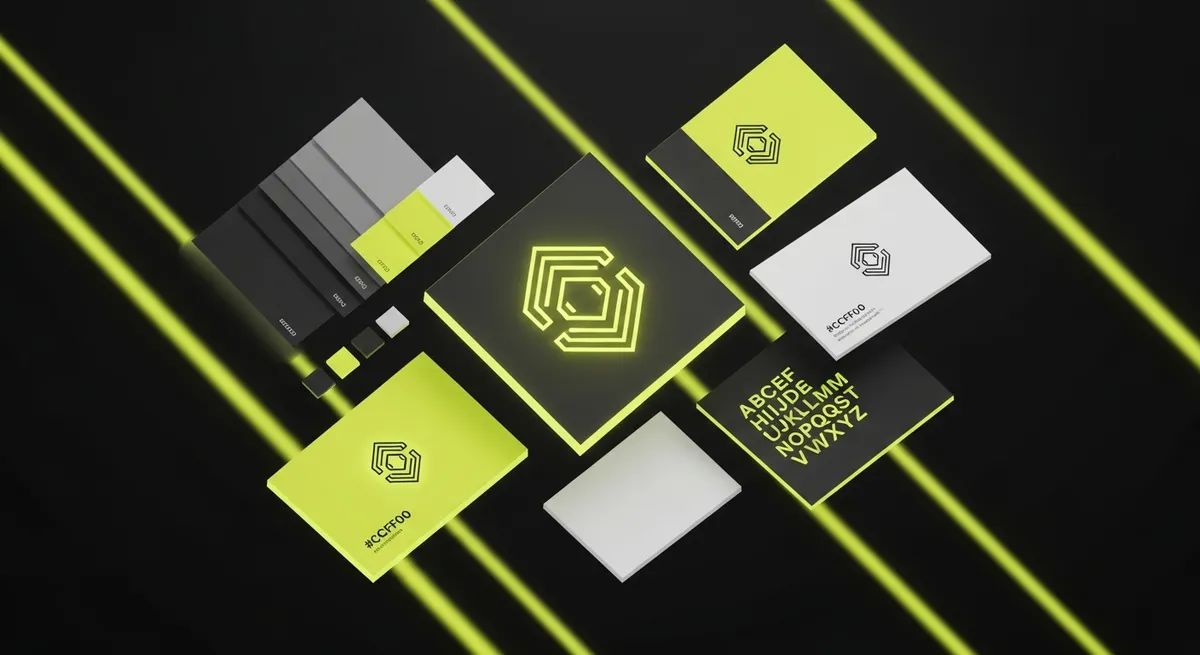
Colors communicate emotions and values: Blue stands for trust and professionalism (UBS, Zurich Insurance), green for sustainability and health, black for luxury and exclusivity, red for energy and passion (SBB, Swiss), and yellow/orange for optimism and accessibility. Define a primary color, 1–2 secondary colors, and neutral tones. Ensure that all color combinations meet WCAGDie Web Content Accessibility Guidelines (WCAG) sind der internationale Standard des W3C für barrierefreie digitale Inhalte. Sie ordnen alle Anforderungen vier…Mehr erfahren → AA contrast requirements.
Typography as a Brand Signature
Fonts communicate character: A serif font (e.g., Playfair Display) appears classic and trustworthy, a geometric sans-serif (e.g., Space Grotesk, Outfit) modern and clean, a display font expressive and memorable. Define a primary font family for headlines and a secondary one for body text, with a clear hierarchy (H1–H4, Body, Caption).
Step 4: Create Brand Guidelines
All decisions from the previous steps must be documented in a brand book: logo variants and safe zones, color codes (HEX, RGB, CMYK, Pantone), typography hierarchy and usage examples, visual language and photography guidelines, brand voice guide with text examples, and dos/don'ts for brand usage. Brand guidelines ensure that everyone – internal teams and external partners – uses the brand consistently.
Branding Budget for Swiss Startups
A realistic branding budget for a Swiss startup: Minimal (logo + basic guidelines): CHF 3,000–8,000, Standard (complete visual identity + brand book): CHF 8,000–20,000, Premium (strategy + visual identity + verbal identity + brand book): CHF 20,000–50,000. The investment pays off through consistent brand communication, higher customer willingness to pay, and stronger brand recognition in the market.
Branding and Digital Touchpoints: Consistency Across All Channels
In the digital world, customers encounter your brand at dozens of touchpoints: website, Google search results, LinkedIn, Instagram, email signatures, invoices, proposals, presentations, business cards, and trade show appearances. Every single touchpoint must consistently represent your brand. A common weakness among Swiss startups: the website looks professional, but LinkedIn posts use different colors, emails feature an outdated logo, and proposals are created in a standard Word template. Create templates for every touchpoint – this costs more initially but saves enormous time in the long run and strengthens brand perception with every contact.
Rebranding: When Is the Right Time?
Not every startup needs perfect branding from day one. But there are clear signals when a rebrand is overdue: the target audience has changed (pivot, new market segment), the current branding no longer reflects the quality of products/services, there is risk of confusion with competitors, the brand has built negative associations, or the company is expanding internationally and the name/design doesn't work in other markets. A professional rebrand in Switzerland typically costs CHF 15,000–40,000 including strategy, design, and implementation. The investment is worthwhile when the current branding is measurably costing business – through low conversion rates, difficulties in customer acquisition, or lack of pricing power.
Employer Branding: Attracting Talent Through a Strong Brand
Switzerland faces a skills shortage in many industries – especially in tech, healthcare, and engineering. A strong brand helps not only with customer acquisition but also with recruiting. According to LinkedIn, companies with a strong employer brand receive 50% more qualified applications and reduce their cost-per-hire by 43%. For Swiss startups, this means: invest early in an authentic representation of your company culture – on the website, LinkedIn, and in job postings. Show what makes your company unique as an employer: flexible work models, interesting projects, development opportunities, and a motivated team.
Branding Budget: What Swiss Startups Should Realistically Plan For
Branding investments should match the company's size and stage. For Swiss startups, we recommend: Pre-Seed / Bootstrapping (Budget: CHF 2,000–5,000): Logo and basic colors (possibly via a specialized freelancer), a simple style guide page with the most important brand elements, and a professional business card design. Seed Stage (Budget: CHF 5,000–15,000): Complete visual identity (logo, color system, typography, visual language), brand guidelines document, and website design in the new branding. Series A and above (Budget: CHF 15,000–50,000): Comprehensive brand strategy with positioning and messaging, design system for all touchpoints, and brand assets for marketing, social media, and events. The most common miscalculation: investing too much budget in luxury branding before product-market fit has been proven.
Branding Is Strategy, Not Decoration
Strong branding is not an aesthetic exercise – it is strategic positioning work that influences every interaction with your company. Swiss startups and SMEs that invest early in their branding build a foundation for sustainable growth, higher pricing power, and loyal customer relationships. The most common mistake: treating branding as "nice to have" and only investing once the brand is already inconsistent in the market.